My neighbourhood has been under renovation for the last few years.
The major arterial road that transects the suburban subsection where I live has been going through an expansion, adding dedicated transit lanes, widening, rehabilitating, and adding capacity through doubling bridges. It has taken years, and there are still a couple of years left.
All this construction, as focused as it has been on car traffic though, has had the side benefit of adding a bunch of new pedestrian trails and three new footbridges (the third yet to be completed as I write this.)
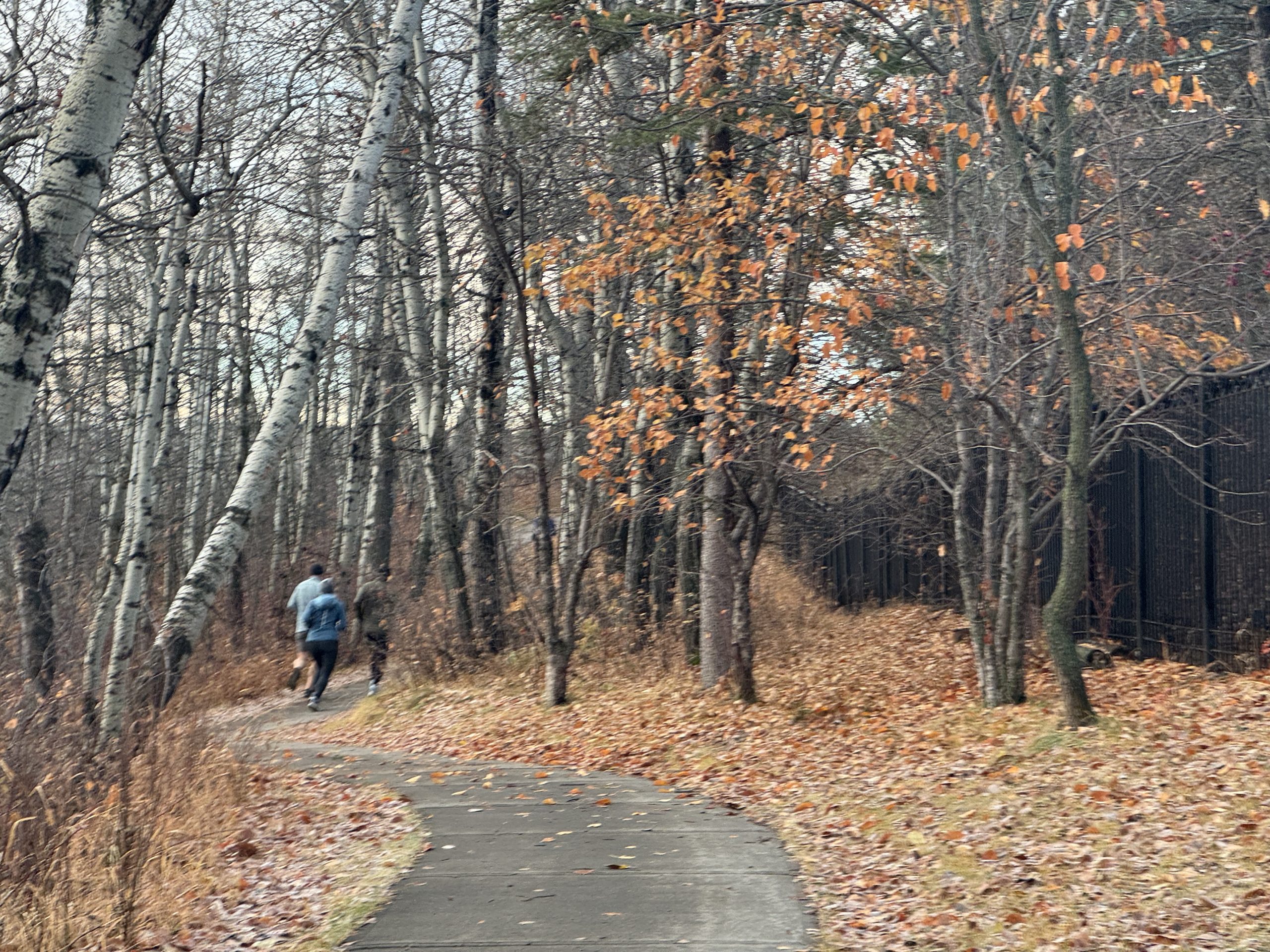
As a runner who spends almost as much time on foot on that trail system as I do in my vehicle, this has been fantastic… and also an adventure in path finding through an ever-changing network of asphalt multi-use trails.
Path finding, of course, is not just about finding routes. It is also about making plans to traverse those routes in a way that is interesting and compelling and, importantly, achievable. It is not worth it, after all, to set out on a trail that loops back after twelve klicks if everyone only was ready to run eight.
We path finders are only trusted so far as our maps match expectations of distance and difficulty. Take a bunch of runners on an adventure that was twice as long as planned and people get mad… or don’t show up for next week’s run.
With all these new trails and paths and bridge connections all the mental mapping I had stored away in my brain after multiple decades of running the local trail network is suddenly supplemented or just plain wrong.
It’s a real labour of love doing this, but it is still hard work. So. Don’t take the path finder in your group for granted. They are always checking out maps and shortcuts and new construction for interesting routes that twist down a new direction and add some mystery and magic to the next run.
And remember, that construction sign often means someone needs to plan a new running route soon.
Definitions
- asphalt paths
- I'm sure running routes are constructed of materials as diverse as the places they are set down, but in my city we pave public trails with 1.5m width of simple black asphalt and call them multi-use corridors. Bikes, scooters, strollers, rollerblades, runners, pets, and pedestrians strolling through the city make use of these paths. They are hot and smooth in the summer, glossy wet in the rain, and often a bit icy (though cleared) in the winter.
- klick
- As a Canadian I run in metric. As a writer, I find the word kilometre clunky and clinical. I'll usually use the colloquial "klick" or "klicks" to substitute in for this.
- suburban
- I live in the suburbs of a big Canadian city called Edmonton, Alberta. We call it home, but a lot of people might look at the manufactured urban sprawl as cluttered with cars and fabricated architecture and big box stores. They're not wrong, but we've found the trails and the parks and entrances into the gorgeous river valley routes that have their own unique identity in our lives. Run where you can.